
ABOUT THE AUTHOR
D.P. Harlan
Stories from places where the road gets narrow and the rules get older.
D.P. Harlan writes Southern Gothic fiction about isolated places, inherited secrets, old promises, and the uneasy distance between what people know and what they are willing to admit.
His work blends horror, folklore, mystery, and the everyday texture of small Southern communities—places where everybody knows everybody, the past is rarely finished, and silence can be as important as evidence.
ABOUT THE WORK
Horror works better when the place feels real.
Moustique began with a simple idea: a town that had survived for generations by learning when not to ask questions.
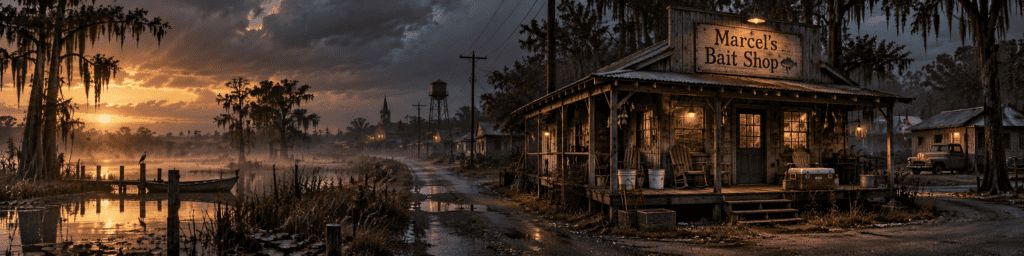
From there came the blackwater, the old roads, the working boats, the weathered houses, the rules repeated without explanation, and the people who understood that folklore was sometimes less about superstition than survival.
The goal was never to build a town that felt haunted.
The goal was to build a town that felt lived in.
The horror could come later.
WHY SOUTHERN GOTHIC
The landscape remembers.
Southern Gothic has always been interested in what people inherit.
Land. Names. Religion. Shame. Violence. Loyalty. Stories.
In Moustique, those things are inseparable from the landscape itself. Water erases roads. Humidity preserves nothing and somehow keeps everything. Old buildings lean but remain standing. Families remember things differently.
And somewhere between the official version and the story told after dark, the truth begins to move.
ABOUT MOUSTIQUE
A fictional Louisiana town with very real rules.
Moustique does not appear on a map.
That has not stopped generations of people from behaving as though they know exactly where it is.
The fictional town sits somewhere beyond the reliable pavement, surrounded by marsh, cypress, blackwater, fishing camps, old family names, and local customs that sound foolish until the frogs stop.
Its people have survived by learning which questions matter.
And which ones do not need answering.
A NOTE FROM D.P. HARLAN
The strangest places are usually the ones that feel familiar.
The stories I like most do not begin with monsters.
They begin with people going to work.
Someone opens a store. Someone checks a fishing line. Someone drives a road they have driven a thousand times. Someone notices the goats have gone quiet.
Then something is wrong.
That is the kind of horror I wanted Moustique to become: grounded enough that the impossible has somewhere solid to stand.
Visit the town before you read what happened there.
Walk the roads. Learn the names. Read the rules. Then decide how much of it you believe.